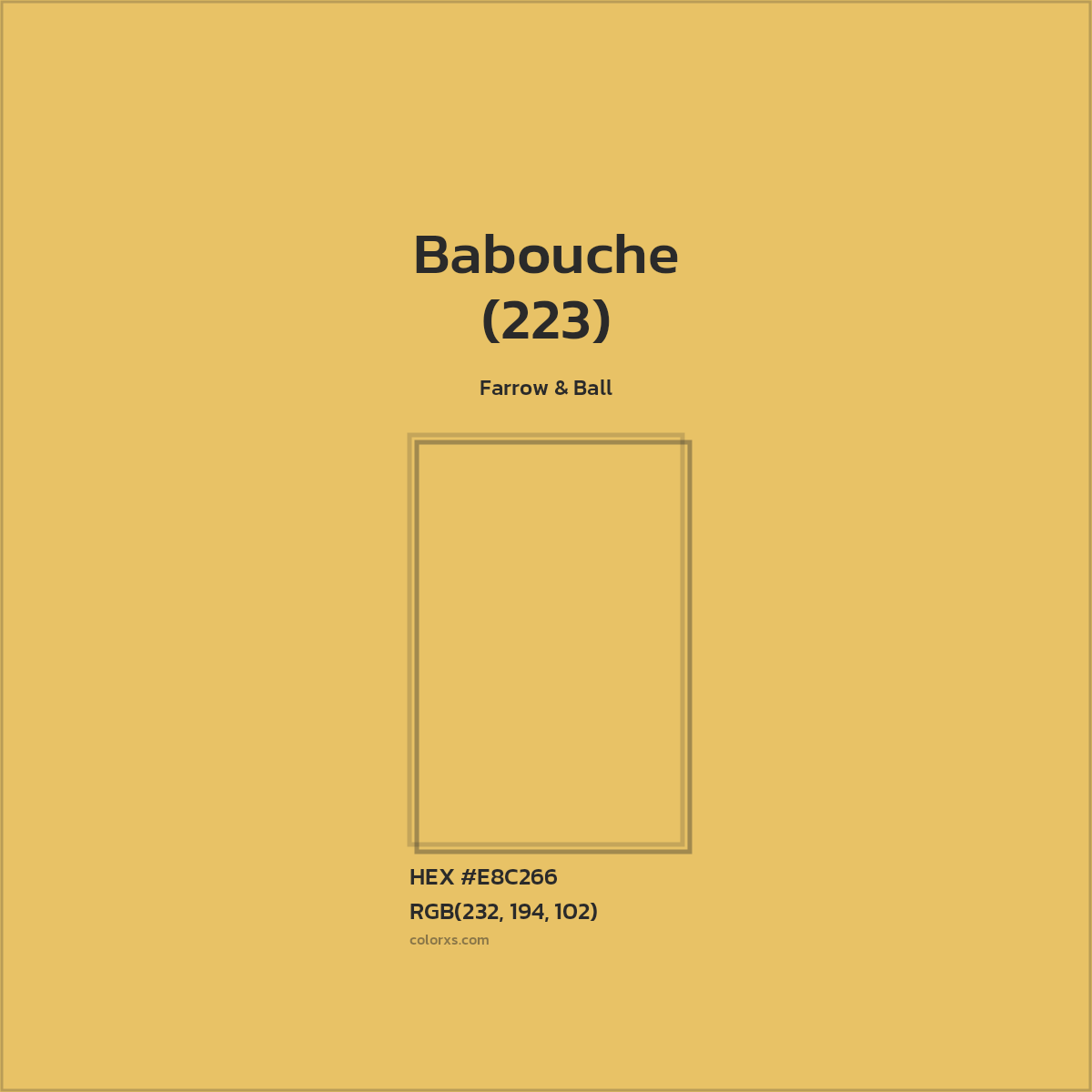
Farrow & Ball Babouche (223) Paint Color

Color Name
Babouche (223)
Hex Color Code
#E8C266
RGB Color Code
RGB(232, 194, 102)
CMYK Values*
0.0%, 16.4%, 56.0%, 9.0%
#E8C266 Babouche (223) Paint Farrow & Ball - Color codes and meaning | Matching colors and paints

Color inspiration, in your inbox

New palettes, color guides and tools from Colorxs.

No spam. Unsubscribe anytime.
About Babouche (223) color - its meaning and example

What color is Babouche (223)?

The hexadecimal color code(color number) for Babouche (223) is #E8C266, and the RGB color code is RGB(232, 194, 102).

In the RGB color model, Babouche (223) has a red value of 232, a green value of 194, and a blue value of 102. The CMYK color model (also known as process color, used in color printing) comprises 0.0% cyan, 16.4% magenta, 56.0% yellow, and 9.0% key (black). The HSL color scale has a hue of 42.5° (degrees), 73.9 % saturation, and 65.5 % lightness. In the HSB/HSV color space, Babouche (223) has a hue of 42.5° (degrees), 56.0 % saturation and 91.0 % brightness/value.

Babouche (223) is cool or warm?

The color Babouche (223) is a warm color.

What is the LRV of Babouche (223)? (For interior and product design)

Babouche (223) has an LRV of nearly 56.7. By LRV value, it is a medium light color.

Light Reflectance Value (LRV) is a measure of how much visible light is reflected off a surface. It is a number on a scale of 0 to 100, with 0 being pure black and 100 being pure white. The higher the LRV, the more light the color reflects and the lighter it will appear.

Dark Color
Babouche (223)
LRV 56.7
Light Color

Compare LRV 56.7 of Babouche (223) with dark and light color

LRV is important to consider when choosing paint colors for a room, as it can affect the overall brightness and mood of the space. Lighter colors with higher LRVs will make a room feel more spacious and airy, while darker colors with lower LRVs will create a more intimate and cozy atmosphere.
LRV value 56.7 puts Farrow & Ball Babouche (223) paint color in the medium category.

  • Darker colors: Darker colors have lower LRV numbers because they absorb more light than they reflect. This means that they will make a room feel darker and smaller.
  • Lighter colors: Lighter colors have higher LRV numbers because they reflect more light than they absorb. This means that they will make a room feel brighter and more spacious.

Color Codes - Color Space Conversions

Babouche (223) (Paint - Farrow & Ball) color codes / color number / color space conversions - HEX, RGBA, CMYK, HSL, HSV/HSB, HYZ, CMY, HWB, RYB

HEX #E8C266
Hex triplet
#E8C266
Red
E8
Green
C2
Blue
66
RGBA / RGB rgb(232, 194, 102)
Red
232 (91.0%)
Green
194 (76.1%)
Blue
102 (40.0%)
Alpha
1 (100.0%)
CMYK
Cyan
0.00%
Magenta
16.38%
Yellow
56.03%
Key
9.02%
HSL hsl(42.46deg, 73.9 %, 65.5 %)
Hue
42.46°
Saturation
73.86 %
Lightness
65.49 %
HSV / HSB
Hue
42.46°
Saturation
56.03 %
Brightness / Value
90.98 %
RYB ryb(43, 120, 22)
Red
43 (17.0%)
Yellow
120 (47.1%)
Blue
22 (8.8%)
HWB
Hue
42.46°
Whiteness
40.00 %
Blackness
9.02 %
CMY
Cyan
9.02%
Magenta
23.92%
Yellow
60.00%
XYZ
X
54.97
Y
56.7
Z
20.62
YXY
Y1
56.7
X
0.42
Y2
0.43
CIE-Lab
L
80.01
A
2.74
B
50.69
CIE-Lch
L
80.01
C
50.76
H
86.9
CIE-Luv
L
80.01
U
30.65
V
61.58
Hunter-Lab
L
75.3
A
-1.47
B
36.48
Other
LRV
~ 56.7 %
Munsell Color System
4Y 7.9/7.8

Similar Colors and Paints

What is Delta E (ΔE)?

Delta E is the standard measure of how different two colors look to the human eye, rather than how far apart their hex codes happen to be. It runs from 0, an exact match, to 100, the largest possible difference — so the lower the Delta E, the closer the match. The match percentage shown on each color below is simply 100% minus its ΔE.

ΔE 0
Identical – an exact match
ΔE under 1
Not perceptible; the eye cannot separate them
ΔE 1 – 2
Perceptible only on close, side-by-side inspection
ΔE 2 – 10
Perceptible at a glance
ΔE over 10
Reads as a different color altogether

Named colors similar to Babouche (223) (Paint - Farrow & Ball)

These are the named colors closest to Babouche (223) (Paint - Farrow & Ball), closest match first. Each card shows how much of the color the human eye sees as the same, measured as Delta E (ΔE).


Similar colors from Pantone, RAL, and other color matching system


RAL Design

Babouche (223) similar/equivalent colors from RAL Design. Conversion of Babouche (223) to RAL Design


Pantone TCX

Babouche (223) similar/equivalent colors from Pantone TCX. Conversion of Babouche (223) to Pantone TCX


Pantone PMS

Babouche (223) similar/equivalent colors from Pantone PMS. Conversion of Babouche (223) to Pantone PMS

#F2C75C Color PANTONE 141 C
97.42% match | ΔE 2.58
#EBBC4E Color PANTONE 2006 C
96.76% match | ΔE 3.24
#E1B84D Color PANTONE 6003 C
96.75% match | ΔE 3.25
#F1BE48 Color PANTONE 142 C
95.77% match | ΔE 4.23

British Standard 4800

Babouche (223) similar/equivalent colors from British Standard 4800. Conversion of Babouche (223) to British Standard 4800


RAL Classic

Babouche (223) similar/equivalent colors from RAL Classic. Conversion of Babouche (223) to RAL Classic


Pantone TPX

Babouche (223) similar/equivalent colors from Pantone TPX. Conversion of Babouche (223) to Pantone TPX

#F5C71A Color Deep Lemon
92.35% match | ΔE 7.65

Paint similar to Babouche (223) (Paint - Farrow & Ball)

These are the real paint colors closest to Babouche (223) (Paint - Farrow & Ball) from major brands, ranked by Delta E (ΔE) match. A paint above 98% will be hard to tell apart from Babouche (223) once it is on a wall.


Farrow & Ball

Babouche (223) similar/equivalent paint from Farrow & Ball. Conversion of Babouche (223) to Farrow & Ball

#E8C266 Color Babouche (223)
Paint - Farrow & Ball
100.00% match | ΔE 0.00
#E0BE6E Color Corngold (9915)
97.73% match | ΔE 2.27
#EDCE82 Color Citron (74)
95.96% match | ΔE 4.04
#DFC380 Color Ciara Yellow (73)
95.38% match | ΔE 4.62

Sherwin Williams

Babouche (223) similar/equivalent paint from Sherwin Williams. Conversion of Babouche (223) to Sherwin Williams


Benjamin Moore

Babouche (223) similar/equivalent paint from Benjamin Moore. Conversion of Babouche (223) to Benjamin Moore


Dunn-Edwards

Babouche (223) similar/equivalent paint from Dunn-Edwards. Conversion of Babouche (223) to Dunn-Edwards


PPG Paints

Babouche (223) similar/equivalent paint from PPG Paints. Conversion of Babouche (223) to PPG Paints


Behr

Babouche (223) similar/equivalent paint from Behr. Conversion of Babouche (223) to Behr


Valspar

Babouche (223) similar/equivalent paint from Valspar. Conversion of Babouche (223) to Valspar


Color Combinations

View more Farrow & Ball Babouche (223) - #E8C266 color palettes and coordinating colors

Monochromatic Color Palette

Monochromatic colors belong to the same hue angle but different tints and shades. Monochromatic color palette can be generated by keeping the exact hue of the base color and then changing the saturation and lightness.

Analogous Color Palette

Analogous colors are a group of colors adjacent to each other on a color wheel. Group of these adjacent colors forms Analogous color scheme Palette. Analogous Palette can be generated by increasing or decreasing the hue value by 30 points.

Triadic Color Palette

The triadic color palette has three colors separated by 120° in the RGB color wheel

Tetradic Color Palette

The tetradic colour scheme composed of two sets of complementary colors in a rectangular shape on the color wheel.

Complementary / Opposite Color

#E8C266
Babouche (223)
#668CE8
Cornflower Blue*

Complementary / Opposite Color

Complementary colors are pairs of colors which, when combined or mixed, cancel each other out (lose hue) by producing a grayscale color like white or black. When placed next to each other, they create the strongest contrast for those two colors. Complementary colors also called opposite colors. Complementary color schemes are created using two opposite colors on the color wheel. The examples are red–cyan, green–magenta, and blue–yellow.

What is the contrasting color of Farrow & Ball Babouche (223) - #E8C266?

Color that best contrast with Farrow & Ball Babouche (223) - #E8C266 is #668CE8, color name is Cornflower Blue*. Contrast indicates a strong difference in color. Contrasting color can be found several ways, Complimentary contrast is one of them. Complementary contrast colors are opposite each other on the color wheel.

What color compliments Farrow & Ball Babouche (223) - #E8C266?

Complementary or Opposite color for Farrow & Ball Babouche (223) - #E8C266 is #668CE8, color name is Cornflower Blue*.

Example Color Images and Mockup

Farrow & Ball Babouche (223) - #E8C266 Color Images and Patterns


Farrow & Ball Babouche (223) Paint vintage style bedroom interior
Farrow & Ball Babouche (223) Paint cozy coffee corner interior
Farrow & Ball Babouche (223) Paint modern minimalist living room interior
Farrow & Ball Babouche (223) Paint dining room design
Farrow & Ball Babouche (223) Paint exterior design modern house with walkway
Farrow & Ball Babouche (223) Paint modular kitchen design